

LEPMI at the heart of the world-first IBIS smart battery

On 19 September, Stellantis unveiled the first prototype electric vehicle equipped with a smart battery. LEPMI* contributed to this world first by developing new fast-charging protocols and analysing the life cycle of this innovative architecture.
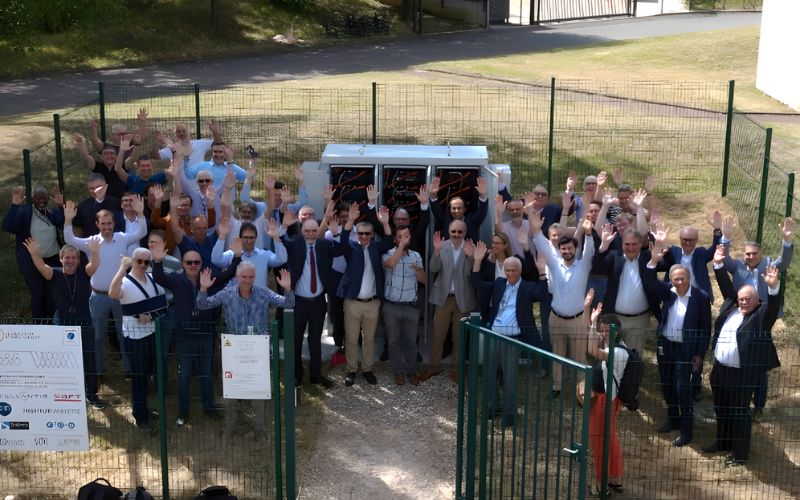
Demonstrated in a fully operational Peugeot E-3008, IBIS (Intelligent Battery Integrated System) technology represents a major departure from conventional battery design. Batteries normally require external components—including an inverter, charger and converter—to operate. IBIS aims to integrate these functions directly into lithium-ion battery modules using electronic circuit boards. The result is a more compact, efficient and cost-effective architecture that increases vehicle range and opens up new opportunities for stationary energy-storage applications.

“The idea is to design a self-contained battery without a separate charger or inverter,” explain the LEPMI researchers involved in the project. “For manufacturers, this means higher-performing, more competitive vehicles. For users, it means greater range and, ultimately, more affordable prices.”
 

LEPMI’s key role

Coordinated by Stellantis in partnership with Saft, several SMEs and three joint CNRS research laboratories, the IBIS project began in 2019. It was partly funded by ADEME under France’s Investments for the Future Programme. At LEPMI, three researchers—Jean-Claude Leprêtre of UGA – IUT1, Yann Bultel of Grenoble INP – Ense3, UGA, and Pierre-Xavier Thivel of Grenoble INP – Polytech, UGA—led two areas of research: the development of innovative fast-charging protocols and battery life-cycle analysis. “We developed charging protocols that are only possible because of the IBIS architecture,” the researchers explain. “Integrating advanced functions directly into the battery allows the charging of each cell to be controlled extremely precisely. We were able to test how these methods affect cell ageing and identify those that maximise battery life.”

This work has resulted in three patent applications and several scientific publications, reinforcing LEPMI’s role in research into electrochemical systems for the energy transition.
 

Technology designed for a second life

Beyond improving performance on the road, the IBIS project also aims to optimise the management of batteries at the end of their first life. The integrated electronics make them easier to reuse in stationary applications, such as storing electricity generated from renewable energy sources. “Stellantis wanted not only to improve batteries for electric vehicles, but also to consider their second life and their integration into the power grid.” The life-cycle assessments conducted by LEPMI identified the environmental benefits of this architecture, as well as potential recovery and recycling routes for batteries at the end of their useful life.

Building on these results, the consortium has now received the green light for a new phase called IBIS 2, supported by Bpifrance under the France 2030 investment plan. Its objective is to raise the technology’s maturity level with a view to industrialisation by the end of the decade. “We began by validating our protocols on a single cell. We are now going to deploy them across an entire module,” says Yann Bultel, Deputy Director of LEPMI. “This is an essential step if the technology is to be incorporated into mass-produced vehicles.”

*CNRS / UGA / Grenoble INP – UGA