

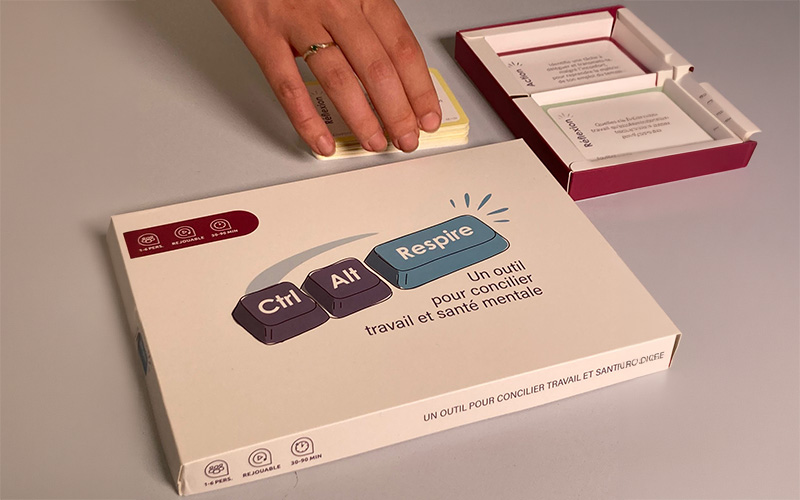
Ctrl Alt Respire opens up conversations about mental health at work

Ctrl Alt Respire is a new tool designed to help organisations prevent psychosocial risks and encourage conversations about mental health at work. Its launch marks the culmination of several years of research into human relationships, management and engagement within organisations.

How can people talk about mental health at work without fear of being judged? How can early signs of distress be identified before they become entrenched? To address these questions, Ludivine Adla, a lecturer and researcher at Grenoble IAE – INP, UGA, developed Ctrl Alt Respire, a tool designed to facilitate dialogue within organisations.

Launched in spring 2026, the tool consists of a set of reflection and action cards designed to create space for conversations about topics that can be difficult to discuss. It is neither a medical diagnostic tool nor a therapeutic intervention, but a resource that helps raise awareness, enables people to express their difficulties and supports the search for appropriate solutions.

Funded through the Grenoble Alpes University Innovation Hub (PUI) as part of an ANR-funded France 2030 project, Ctrl Alt Respire is already finding an audience in the workplace. SNCF, Manufacture d’Histoire Deux-Ponts and Axens have purchased sets, while the tool is attracting interest from occupational psychologists, human resources departments and professional coaches.

Ludivine Adla
A longstanding focus on human relationships

Although mental health is currently in the spotlight, the topic builds on research Ludivine Adla has pursued since the start of her career. “Human relationships have been the driving force behind my research from the very beginning,” she explains. In 2023, she secured funding from the French National Research Agency (ANR) to investigate the relationship between human resource management and innovation in small and medium-sized enterprises (SMEs), through the lens of business leaders’ attachment orientations. Conducted with four companies in the Grenoble ecosystem, the project explores, in particular, the role of interpersonal behaviours and emotional patterns.

Initial findings show that leaders with a predominantly secure attachment orientation are better able to cooperate and encourage initiative. Conversely, certain forms of insecurity can lead to a more control-focused management style that is less conducive to innovation.
 

From innovation to well-being at work

Throughout her research, Ludivine Adla, a lecturer and researcher at Grenoble IAE – INP, UGA, has explored concepts such as recognition, engagement and support. One finding emerges repeatedly: the quality of human relationships influences both collective performance and the quality of working life and working conditions.

This work gradually led her to investigate the factors that shape mental health at work. Management quality, workload, recognition, work–life balance and alignment between organisational and employee values can all have a lasting impact on psychological well-being.

With Ctrl Alt Respire, Ludivine Adla is taking this work a step further by translating scientific knowledge into a practical tool for organisations. The initiative reflects her commitment to connecting academic research with businesses and other organisations to help create healthier working environments.


Recueil d'articles