
Unite-EN
University Network for Innovation, Technology and Engineering
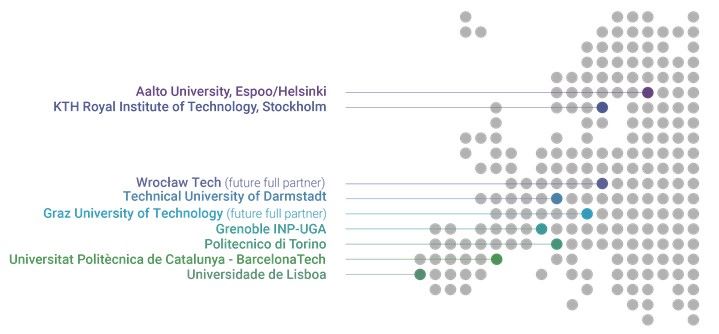
Unite! is a network of universities from currently nine countries in Europe. The network has been established to create a new model of a trans-European inter-university campus – for students, researchers and all staff.Combining aspects of science, innovation and technology, this alliance is working to address the major societal challenges that will arise in the future. And it will transform European higher education – by offering multidisciplinary, multicultural and multilingual education, research and innovation involving regions and businesses.
Key activities:
- Mobility for all students, extending to new short-term programmes, summer schools and joint programmes.
- Mobility for all staff, including thematic staff weeks and a teaching staff pilot community that will test innovative ways of teaching.
- Virtual Campus that includes a platform for digital mobility, virtual spaces and online tools.
- Teaching and Learning Academy to help professors and educators develop models for flexible study paths and innovative pedagogies.
- Trans-regional network for open innovation and entrepreneurship that enables sharing of local and regional education, supports services for future entrepreneurs and aims to provide input to regional strategies, e.g., Smart Specialisation.
Alliance structure and the role of Grenoble INP - UGA
Unite! is coordinated by TU Darmstadt (Germany). Since late 2025, the presidency of the alliance has been held by Grenoble INP - UGA, officially represented by its President, Vivien Quema. The day-to-day operations of the alliance continue to be managed by the Unite! Secretariat, which is also based at TU Darmstadt.The strategic and operational objectives of Unite!, both short and long-term, are defined by specialised working groups. Grenoble INP - UGA plays a pivotal role, not only through its presidency but also by leading the "Professional Development and Training" and "Sharing of Research Infrastructures and Resources" communities. Furthermore, the institution contributes to sub-tasks within the "Language Centre" and "Internationalisation at Home" communities. In total, more than 80 staff members and students from Grenoble INP - UGA are actively involved in shaping and developing the Unite! alliance.
The Unite! partner universities:
- Technische Universität Darmstadt (Germany)
- Aalto University (Finland)
- Grenoble INP - UGA (France)
- KTH Royal Institute of Technology (Sweden)
- Politecnico di Torino (Italy)
- TU Graz (Austria)
- Universitat Politècnica de Catalunya · BarcelonaTech (UPC) (Spain)
- Universidade de Lisboa (Portugal)
- Wroclaw Tech (Poland)
What does Unite! do?
- For students
- Unite! offers new forms of student mobility, joint programs, online courses, summer schools, researcher seminars and collaborative courses, which may include short-term mobility periods. Courses and other activities are mainly offered for master's and doctoral students, but many events and project courses are also suitable for bachelor's students.
- For doctoral students
- Jointly developed European doctoral programmes where research connects with learning, innovation and entrepreneurship. Mobility within Unite!
- For staff and faculty
- All staff working in Unite! partner universities can carry out mobilities, especially during themed Staff Weeks. Staff are encouraged to participate in Unite!work packages when relevant. Staff have access to the Teaching and Learning Academy, which aims to guide teachers develop flexible and pedagogically innovative academic career.
- For society
-
Unite! aims to make the research and innovation environment accessible and inclusive by enhancing the awareness and involvement of citizens and societal organizations on how the SDGs and related R&I initiatives affect and improve their lives and to define a strategy on how to involve societal organizations in the research and innovation activities carried out by the alliance.
Gains from accessing Unite! offerings

Unite! Student Catalogue
Learn more

Unite! metacampus
Learn more

Unite! Faculty & Staff
Community Platform
If you work in any of the 9 Unite! partner universities, whether you are faculty or staff, then you are already part of the Unite! community! Discover the opportunities available to you on this digital platform.
Latest news from Unite!
Stay informed and discover the latest news from the Unite! alliance – highlighting cutting-edge projects, high-impact collaborations and inspiring successes.
-
When the Alps become your classroom
Five Unite! students. One week in the French Alps. An experience that stays with you.
-
Unite! Secures EU Funding for Next Phase Starting November 2026
The European Commission has confirmed funding for the Unite! alliance for a new two-year phase starting in November 2026, thereby expanding opportunities for its students, staff and faculty.
See more news
Upcoming events
-
Unite! Language tandems registration 2026-2027
-
- to
-
-
Save the Date: XII Unite! Dialogue at Aalto University
-
- to
-
See more events
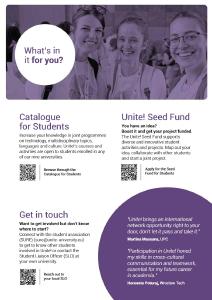
Brochures Unite!
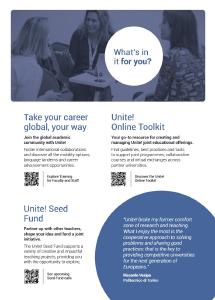
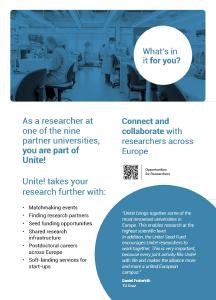
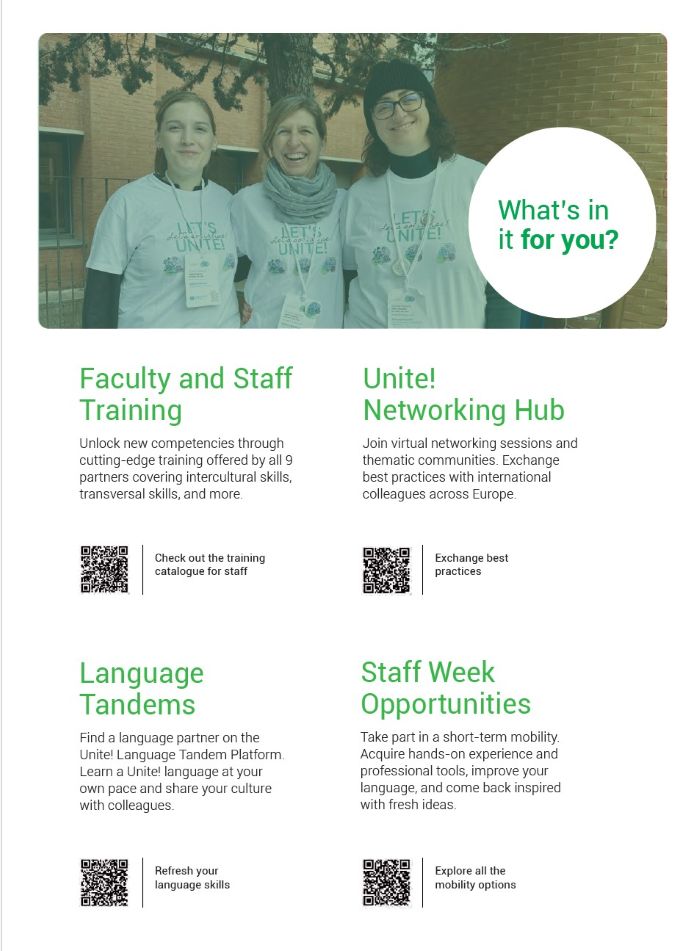
More about Unite!
Unite! Contacts at Grenoble INP - UGA
- Key Liaison Officer: Franz Bruckert
- Deputy Key Liaison Officer: Constance Chevallier-Govers
- Student Liaison Officer and Widening coordinator: Elisa Hausherr
- Unite! team manager: Clémentine Laforet
- Administrative and Financial Assistant: Céline Bussières
- Cm.3 and Cm.8 local coordinator: Lucie Jiraskova
- Cm.6 coordinator: Barbara Guyomarch
- Cm.7 local coordinator:
- Cm.9 local coordinator: Stéphane Boivin
- Scientific Coordinator of the aUPaUE project: Stéphanie Nastasi
Additional projects
To broaden and diversify the fields of cooperation among the members of the alliance, there is a continuous search for partnership and funding opportunities beyond the Erasmus+ project. Currently the following projects are ongoing alongside the main Erasmus+ project:- A University Partnership for Acceleration of European Universities (aUPaEu) The consortium of five academic institution from EPiCUR and Unite! alliances aims to revive the spirit of the agora by fostering collaborative environments that empower stakeholders.
- ED-AFFICHE facilitates the delivery of a joint European degree label. The project consortium is composed of six university alliances.
- GreenChips-EDU is an international project led by TU Graz bringing together six Unite! universities, companies and research institutions with the aim of training urgently needed specialists for the semiconductor industry.
- Unite!.WIDENING aims to be a complementary project extending the outcomes of the already ended UNITE.H2020 project, in particular, to become a role model for a competitive European University Alliance producing top-class R&I and combining it with a virtual and physical seamless inter-university campus, embedded in a network of innovative regions, aiming at a more sustainable world.
 Co-funded by the European Union. Views and opinions expressed are however those of the author(s) only and do not necessarily reflect those of the European Union or the European Education and Culture Executive Agency (EACEA). Neither the European Union nor EACEA can be held responsible for them.