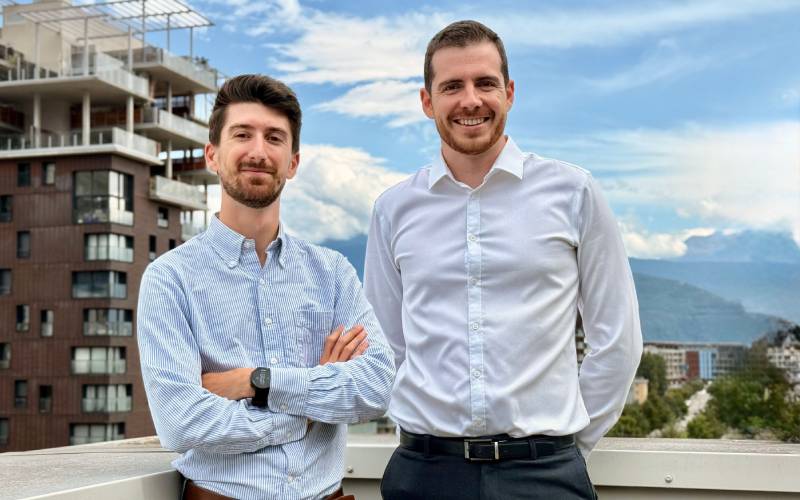
The start-up SUMOT was founded on 30 October 2025 by Robin Thomas and Quentin Loeuillet, two engineers with PhDs who studied at Grenoble INP – UGA, following a lengthy process of scientific and technological development. Its solution stems directly from research conducted at G2Elab*, a laboratory jointly supervised by Grenoble INP – UGA. “SUMOT is the culmination of almost ten years of research at G2Elab. My PhD was the final stage before the technology could be brought to market,” explains Robin Thomas. After graduating from Grenoble INP – Ense3, UGA, he went on to pursue a PhD at the laboratory. His business partner Quentin Loeuillet, also a graduate of the school, followed a similar path, working in collaboration with automotive supplier Valeo.
The research received the Université Grenoble Alpes Innovation Award in 2023. The project was subsequently supported by Linksium before the company was founded.
Designing around how electric motors are actually used
SUMOT began with an observation widely shared by both researchers and industry. Electric motors, particularly those used in mobility applications, are sized to cope with extreme situations, even though these conditions occur very rarely in real-world use.
“A vehicle is stationary more than 90% of the time and, when it is moving, it generally operates at low power. Yet motors are designed for extreme conditions,” Robin Thomas points out. This discrepancy results in motors that are oversized, heavy and expensive, and which require large quantities of critical materials, particularly the rare earth elements used in magnets. Research conducted at G2Elab therefore explored an alternative approach: optimising motors for their most frequent operating conditions while retaining their ability to deliver high performance when occasionally required.
An innovation in power electronics
SUMOT’s solution is based on an innovation in power electronics. It takes the form of an inverter incorporating a “boost” function that can deliver additional power whenever necessary. The technology relies on controlling the magnetic flux within the electric motor by temporarily increasing its density. “The idea is comparable to a turbocharger, but applied to electric power,” the co-founder explains. “We provide additional performance only when it is needed, allowing us to completely rethink how the motor is sized.”
Inspired by both power grids and turbocharging systems, this approach paves the way for more compact motors that are better suited to real-world uses while retaining the performance required in the most demanding situations.
A system-level approach inherited from research
Beyond its core technology, SUMOT advocates a comprehensive approach rooted directly in the laboratory’s research culture. Introducing this boost function provides an additional degree of freedom when designing electromechanical systems. “Optimising an entire system produces far better results than simply combining components that have each been optimised separately. With this technology, we can rethink the motor, the battery and the way they are controlled.”
This system-level approach offers the prospect of significant gains in energy efficiency, lower costs and a reduced material footprint, while addressing industrial and sovereignty challenges relating to supply chains.
Initial markets before scaling up
While the automotive industry is a medium- to long-term objective, SUMOT is initially targeting more accessible markets, including micromobility, urban delivery quadricycles and materials-handling equipment. “These are applications in which compactness and the ability to deliver occasional bursts of power are particularly important. They allow us to test the technology rapidly under real-world conditions.”
These initial markets will enable the start-up to structure its business and gradually bring its technology to the level of maturity required for automotive applications, with discussions already under way in this sector.
A start-up still rooted in G2Elab
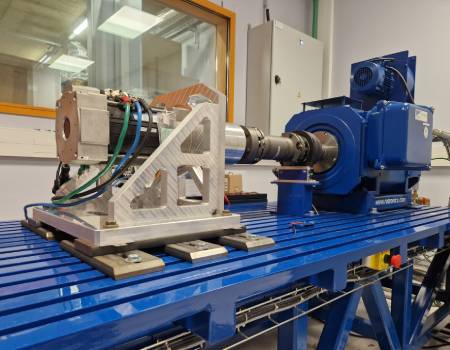
SUMOT currently has two operational co-founders and receives scientific support from Hervé Chazal, a researcher at Grenoble INP – UGA who supervised the PhD research from which the project emerged. The company will remain based at G2Elab until summer 2026 and uses the laboratory’s experimental facilities, including its medium-power motor test benches. Its first new recruit, a graduate of Grenoble INP – Phelma, UGA, is due to join the team shortly to strengthen its R&D activities. During 2026, the start-up plans to expand its workforce before beginning an industrialisation phase with partners.
*CNRS / UGA / Grenoble INP - UGA