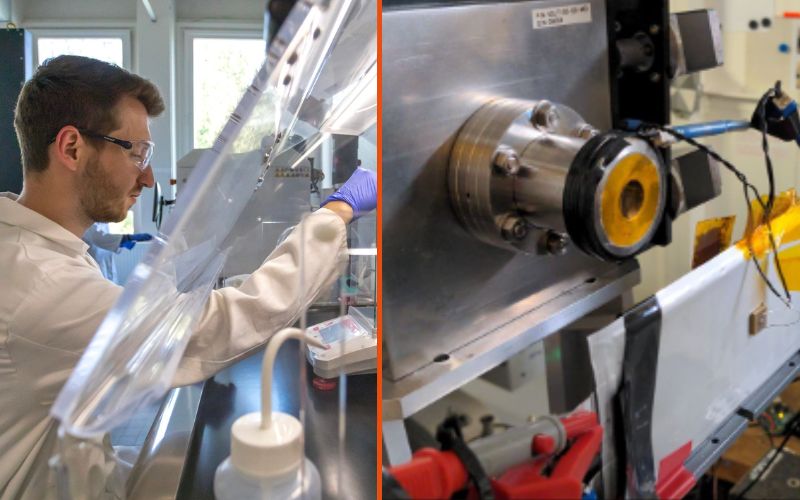
Originally from the Mayenne region, Corentin Renais completed a Bachelor’s and then a Master’s degree in chemistry in Angers before moving to Grenoble to pursue a PhD* at LEPMI**. His research focuses on a crucial challenge for electric mobility: enabling batteries to charge more rapidly. In particular, the young researcher has studied graphite negative electrodes, which are known to limit battery power.
As part of his PhD, he also contributed to a study led by Claire Villevieille, a CNRS researcher at LEPMI, which resulted in a paper published in the prestigious journal Nature Communications.
Revealing cracking sounds
"People do not always realise it, but the batteries in our phones are effectively chemical reactors that we carry around in our pockets,” says Claire Villevieille. “During every charge and discharge cycle, lithium moves back and forth between the electrodes. This movement causes swelling, microcracks and sometimes even gas emissions. These phenomena generate sounds—similar to tiny cracking noises—that can be recorded using acoustic and ultrasonic sensors.”
The research team used large-scale scientific facilities to correlate these acoustic emissions with internal transformations observed through diffraction and imaging. This enabled the researchers to identify which battery component—the electrode, electrolyte or separator—was producing a particular sound at any given time.
Preventing batteries from catching fire
This discovery opens up highly practical possibilities. Integrating a miniaturised acoustic sensor into the battery management system (BMS) could make it possible to detect early warning signs of a safety issue and shut the system down before it catches fire. “It is a way of listening for the sound of a major safety failure within a battery so that we can prevent it from catching fire,” Corentin Renais explains.
Beyond safety, this approach could also provide a better understanding of the current limitations of fast charging. The young researcher’s PhD work is continuing at laboratory scale, varying parameters such as electrode porosity, active-material loading and binder composition. All these parameters can affect both fast-charging performance and the mechanical behaviour of electrodes.
Bridging fundamental research and industrial applications
Although this study arose from a fundamental research question, it has numerous potential applications, ranging from batteries for electric scooters to those used in more powerful vehicles. The project already benefits from close ties with industry.
For Corentin, who is currently completing his PhD, this experience illustrates the importance of combining cutting-edge research, advanced instrumentation and societal challenges. “We all want batteries that are both powerful and quick to charge. By listening to what is happening inside them, we can better understand their limitations and pave the way for new solutions,” he concludes.
*Thèse Grenoble INP - UGA, avec le soutien de la Région Auvergne-Rhône-Alpes
**USBM / CNRS / UGA / Grenoble INP - UGA