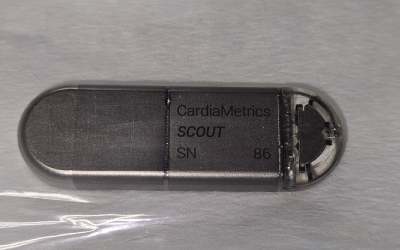
More effective monitoring of patients with chronic heart conditions: this is the ambition of CardiaMetrics, a start-up founded in Grenoble in late 2023. The company is developing a miniature sensor implanted beneath the skin that can measure physiological parameters relating to heart function every day and automatically transmit the data to medical teams.
The start-up was founded by Thibault Parmentier, Cindy Michel, Mathieu Ruhlmann and cardiologist Rémi Sabatier. A 2004 graduate of Grenoble INP – Polytech, UGA, Mathieu Ruhlmann is now contributing to the development of this technology, which emerged from research conducted in Grenoble. “When Thibault asked me to co-found CardiaMetrics, it did not take me long to say yes! The project made sense to me and to those close to me, so I took the plunge. Getting started was far from easy, but the venture now seems to be heading in the right direction!”
Technology originating from the TIMC laboratory
CardiaMetrics’ solution draws on several years of research carried out at the TIMC laboratory*. This work focused on developing implantable sensors capable of measuring indicators of cardiac function, with the aim of improving the long-term monitoring and care of patients.
The project was conceived by Professor Philippe Cinquin, former director of the TIMC laboratory. The initial research explored the potential of sensors implanted in the stomach to monitor cardiac function and led to a first technology transfer initiative through the start-up SentinHealth.
These sensors laid the technological foundations that ultimately led to the creation of CardiaMetrics. The young company is continuing this work by further developing the technology, with support from Grenoble’s research and innovation ecosystem, among others.
Automated patient monitoring
Many remote patient-monitoring systems currently rely on patients taking their own measurements or completing questionnaires at home. This can affect the regularity of the data collected and place a considerable mental burden on people who have already been weakened by illness.
The device developed by CardiaMetrics aims to fully automate the collection of this information. Once implanted beneath the skin, the sensor measures physiological parameters every day and transmits the data to medical teams, without requiring any action from the patient.
This approach promises more reliable and responsive monitoring, particularly for patients with chronic heart failure. Analysis of the data could also help detect a deterioration in a patient’s health at an earlier stage. In the longer term, the same approach could benefit other patients, such as those receiving treatments that may affect cardiac function, including certain forms of chemotherapy.
Towards first-in-human studies
After a first clinical study conducted at Caen University Hospital, CardiaMetrics is now preparing the first-in-human study of its implant, planned between 2026 and 2028, to assess the device’s performance and its potential benefits for patient care.
The next objective will be to obtain the necessary regulatory authorizations, including CE marking in Europe and clearance or approval from the US Food and Drug Administration (FDA). In the longer term, the start-up aims to roll out its solution across Europe and North America and contribute to the development of new approaches to the remote management of chronic diseases.
* CNRS / UGA / VetAgro Sup / Grenoble INP - UGA
Photo credits: Adobe Stock, CardiaMetrics
Crédits photo : Adobe Stock, CardiaMetrics