

From the laboratory to medtech: the ambition of digital twins

A graduate of Grenoble INP – Ensimag, UGA, Mathieu Bailet is the co-founder of Twinsight. Together with his partners, he is developing a digital twin of the knee to personalise knee replacement surgery. His career lies at the intersection of research, engineering and entrepreneurship.
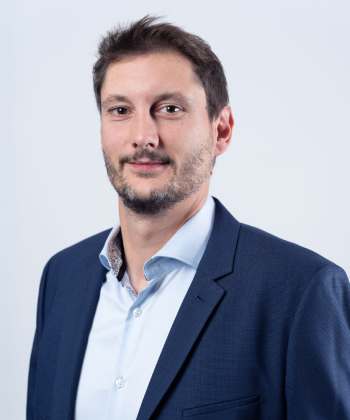
Mathieu Bailet graduated from Grenoble INP – Ensimag, UGA, in 2011, specialising in modelling. He developed an early passion for numerical simulation and the mathematical methods used to represent complex phenomena. His final-year internship at the TIMC laboratory* in Grenoble opened up a new field of application for these skills: medicine.

He went on to complete a PhD in biomechanics focusing on the simulation of physiological phenomena. After conducting research in neurosurgery, he turned his attention to modelling childbirth in order to develop simulators for training healthcare professionals. This experience also revealed one of the limitations of academia: many promising innovations remain in laboratories because they are never transformed into products.

Turning laboratory technology into a product

Together with Marek Bucki, also a graduate of Grenoble INP – Ensimag, UGA, and clinician Antoine Perrier, he decided to take the plunge. The three were working on digital-twin technology arising from their research. In 2020, they founded Twinsight with Mathieu Rimaud, a specialist in medical devices and their commercialisation. The team’s complementary expertise proved decisive: research, clinical knowledge and industrial experience came together to structure the project and turn it into a business venture. “Many promising technologies remain in laboratories. Our ambition was to transform them into products that are useful to doctors.”

A digital twin to support surgeons

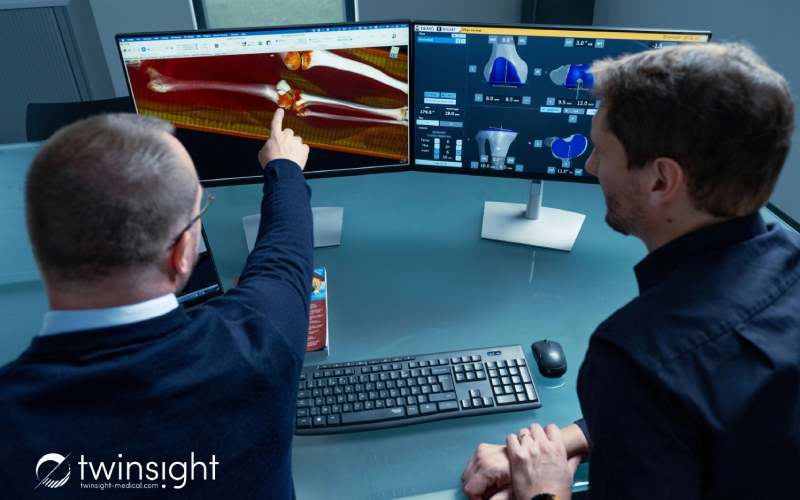
The technology developed by Twinsight creates a personalised biomechanical model of a patient’s knee. Starting from a CT scan of the patient, anatomical structures—including bones, ligaments and the kneecap—are reconstructed and then dynamically simulated using a personalized biomechanical model.

Before the operation, the surgeon can test different positions for the implant and access objective indicators to refine the surgical plan. “In many industries, products are simulated before they are manufactured. In medicine, the patient is often their own prototype. Our aim is precisely to make virtual testing possible before surgery,” the engineer explains.

From scientific development to technical management

Mathieu Bailet is now Chief Technology Officer at the start-up. While his early work focused on scientific development—including modelling, image processing, numerical simulation and artificial intelligence—his role has evolved as the company has grown.

Twinsight now employs thirteen people, most of whom are engineers. “I had to learn how to structure the development process and manage a team,” he says. To help them navigate this transition, the founders completed the HEC Challenge+ programme, which supports entrepreneurs from scientific backgrounds.


Strong roots in Grenoble

Despite its international development, Twinsight remains closely connected to Grenoble’s innovation ecosystem. The company collaborates with the TIMC laboratory through a joint research laboratory and regularly recruits local graduates. “We maintain strong ties with Grenoble INP – Ensimag, UGA. Its degree programmes are excellent, and the school provides a valuable talent pool for the company.”

In 2024, the start-up reached a major milestone by securing FDA clearance to market its solution in the United States, the world’s largest market for knee implants. This marked a decisive step forward for the young company, which is already working to extend its technology to other joints.

*CNRS / UGA / VetAgro Sup / Grenoble INP - UGA
Photo credits: Twinsight