

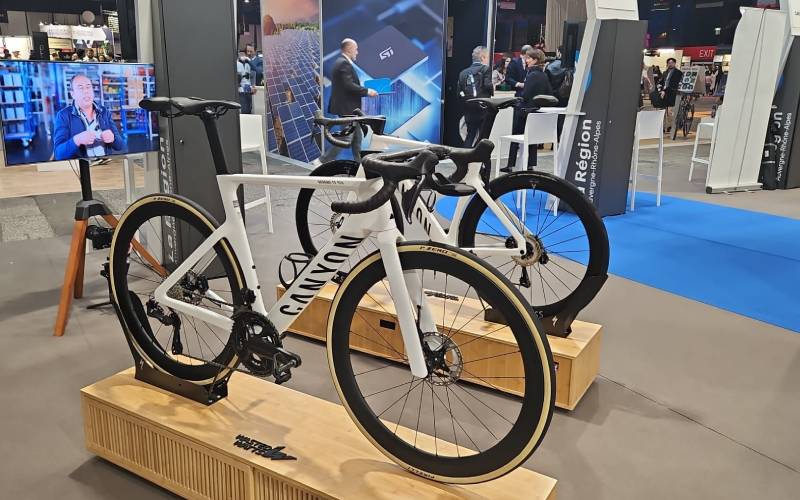
Aeroscale: measuring resistance to boost performance

Start-up Aeroscale is developing technology that measures, under real-world conditions, the forces slowing cyclists down. Students from Grenoble INP – Esisar, UGA, helped design a key sensor, while a collaboration with GIPSA-lab is currently being explored.

On flat terrain, cyclists expend most of their energy overcoming two types of resistance: aerodynamic drag and rolling resistance. Yet these parameters remain difficult to measure under real-world conditions. Until now, professional teams have relied on large and costly facilities such as wind tunnels and velodromes.

Founded in Meylan in late 2020 by Manuel Sellier, an engineer who previously worked at STMicroelectronics and Soitec, Aeroscale is tackling this problem by developing a solution that takes the wind tunnel directly onto the road. Its system combines several sensors with a patented protocol to accurately estimate the overall “energy cost” of a cyclist in motion. “This approach provides objective measurements of the impact of changing a rider’s position, helmet, tyres or equipment,” he explains. “Professional teams and equipment manufacturers can then compare different configurations and identify those that reduce resistance most effectively.”
 

A contribution from Grenoble INP – Esisar, UGA students

To develop its technology, Aeroscale drew on the industrial projects undertaken by students at Grenoble INP – Esisar, UGA, an engineering school specialising in embedded systems and connected devices.

As part of an Easytech industrial project, a group of students worked on designing a prototype power sensor intended to serve as a reference for measurements. The aim was to compare the data obtained with readings from commercially available power meters and assess their accuracy in the specific context of the measurement protocols developed by Aeroscale.

This work helped improve the reliability of the system and provided a better understanding of the limitations of existing sensors. One of the students involved in the project, Brazilian student Juan Vasconsuelos Lopez, subsequently continued working with the start-up through an internship. He has now returned to Grenoble INP – Esisar, UGA, where he is preparing a PhD.
 

From applied research to innovation

Aeroscale is currently pursuing two complementary areas of development. Through its Bike Speed Lab service, the company provides advanced measurement services to professional teams and equipment manufacturers. It is also preparing to launch an onboard solution for the general public called Wasted Watts Tracker.

In time, this technology could extend beyond cycling alone. The methods developed by the start-up can be used to characterise energy losses in any wheeled system, opening up opportunities in the fields of mobility and energy efficiency.
 

A potential collaboration with GIPSA-lab

To further improve its solution, Aeroscale is now considering strengthening its ties with Grenoble’s academic ecosystem. A collaborative project focusing on data-fusion methods is currently being explored with GIPSA-lab*.

The aim would be to simplify certain measurement systems, particularly by exploring technological alternatives to the centimetre-level GPS system currently used. By combining several sources of information, researchers could help make these measurements more robust and easier to deploy.

Such a collaboration would provide another illustration of the dynamic relationship between Grenoble’s technology start-ups and research laboratories, where academic expertise helps drive industrial innovation.

*CNRS / UGA / Grenoble INP - UGA