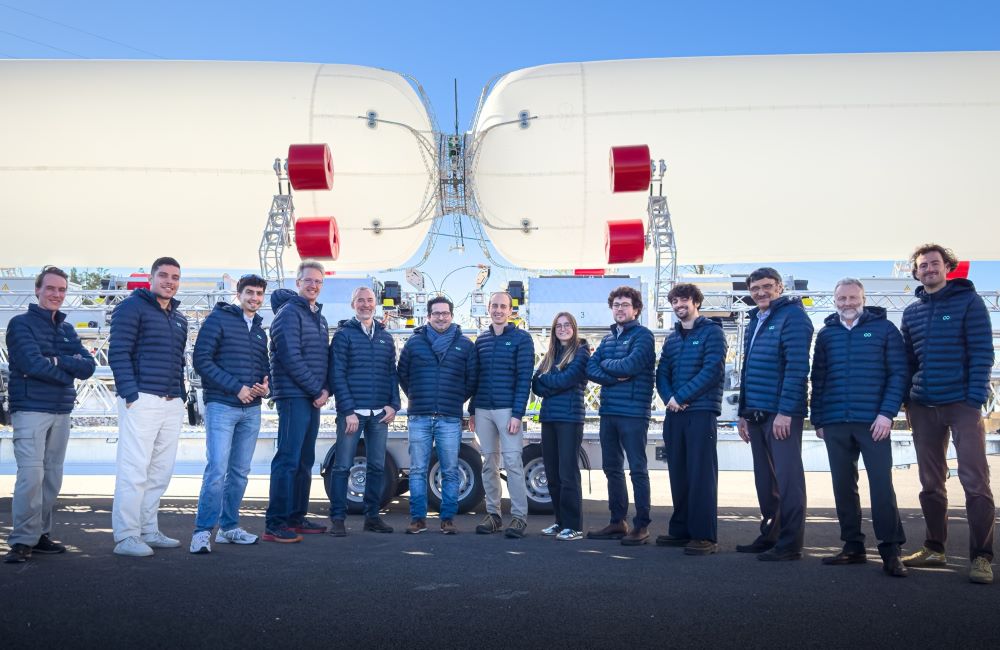
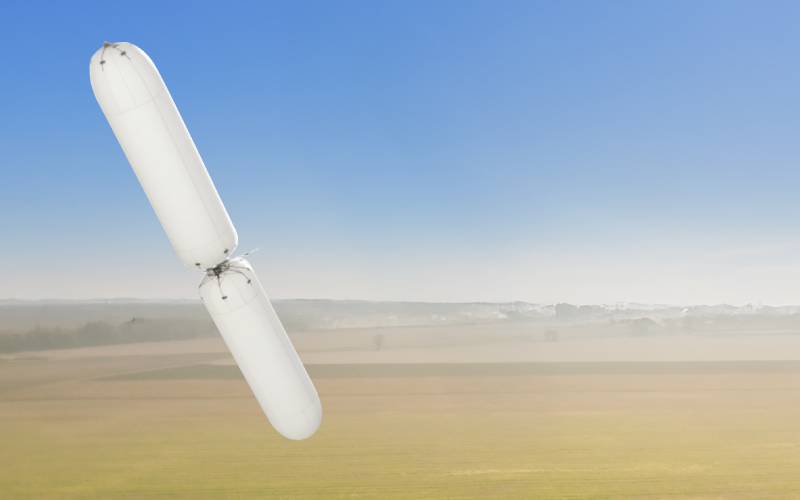
When Wind Fisher announced the successful flight of its 15-metre prototype at the Transpolis testing facility in Saint-Maurice-de-Rémens in November 2025, it marked the culmination of a lengthy development process involving Grenoble’s scientific community. Named MAG, the helium-filled cylindrical wing took off autonomously, flew in a loop and returned to the ground automatically, entirely controlled by algorithms developed with teams from Grenoble-based laboratories. This success represents a turning point for the airborne wind turbine, designed to harness the powerful, steady winds found several hundred metres above conventional wind turbines.
At the heart of this innovation lies the Magnus effect, a physical phenomenon familiar to tennis enthusiasts. When a player applies heavy topspin to a ball, its rotation generates a lateral force that alters its trajectory. Wind Fisher applies this principle on a much larger scale: its rotating cylindrical wing generates a lateral force that propels it through the air mass. Connected to the ground by a tether, it transfers this force to a ground-based generator, converting motion into electricity. This approach provides access to a largely untapped wind resource: high-altitude winds, which are twice as fast and far more consistent than those found at ground level.
A lighter, more productive and more sustainable alternative to conventional wind power
By dispensing with the massive structures required by ground-based wind turbines, Wind Fisher’s system achieves greater efficiency. The helium-filled wing requires very little material, needs no concrete foundations and can be deployed in less than a day, including in remote areas. The entire system is far more compact than a conventional wind turbine, with a smaller ground footprint and a fully reversible installation. Most importantly, by capturing high-altitude winds, the turbine can produce twice as much electricity as a conventional wind turbine with the same rated capacity, and up to five times more than a photovoltaic installation. It could operate at full power 60% of the time—an exceptionally high capacity factor for a renewable energy source. Its ability to land automatically during storms also reduces mechanical risks, making the system safer and more robust.
Mathematical models at the heart of the control system
The technology’s current level of maturity is partly the result of Wind Fisher’s long-standing collaboration with GIPSA-lab. Since 2015, the laboratory has been supporting the start-up in modelling and controlling the system. Nacim Meslem, an associate professor at Grenoble INP - UGA, assists Wind Fisher with the integration of mathematical models used to control the system and estimate the forces acting on it during flight. Developed by Armand Tardella, Chief Scientist at Wind Fisher, these models provide a precise description of the wing’s behaviour in flight. They are used to design control laws capable of operating the turbine in sometimes extreme wind conditions. They also make it possible to estimate in real time the forces exerted on the wing once it is airborne—essential information for adjusting the control system, optimising its trajectory and accurately quantifying the energy produced. GIPSA-lab has also contributed its expertise in avionics and mechatronics, drawing on its national aerial robotics platform, which is part of Robotex 2.0. The partnership has become so close that the two organisations have submitted a proposal to the French National Research Agency (ANR) to create a joint laboratory and are currently awaiting its decision.
At the same time, LEGI is helping to overcome the scientific challenges associated with the aerodynamics of the rotating cylinder. Since 2023, a CIFRE industrial PhD project conducted by Alessandro Genoni and supervised by Christophe Sicot from Institut Pprime in Poitiers and Stéphane Barre from LEGI in Grenoble has been investigating the phenomena associated with the Magnus effect. This research is providing a clearer understanding of real flight conditions and helping to refine the design models for future prototypes, MAG25 and MAG80, which are currently under development.
Wind Fisher is now preparing for the pre-industrialisation of its first systems and aims to become a major player in the renewable energy sector. By bringing together control systems engineers, robotics specialists and aerodynamicists around a disruptive project, Grenoble INP - UGA is reaffirming its key role in advancing the technologies that will support the energy transition.
*CNRS / UGA / Grenoble INP - UGA