
Émilien Fréville received two distinctions at the 2024 Université Grenoble Alpes PhD Thesis Awards: the Innovation Award and the Corporate Social Responsibility Award. These prizes recognised the research he carried out at LGP2* during his PhD. A 2021 engineering graduate of Grenoble INP – Pagora, UGA, he completed his thesis in collaboration with CTP, the French Technical Centre of Paper. His work focused on developing a new process for manufacturing high-performance cellulose-based packaging that are recyclable and easy to produce on an industrial scale.
The goal was ambitious: to replace certain types of plastic packaging with three-dimensional objects made from cellulose fibres, using techniques borrowed from plastics processing, such as extrusion, injection-moulding and thermocompression. Building on these established processes, which are already widely used in industry, could help reduce costs and accelerate the uptake of more sustainable solutions.
An “injectable” paper pulp
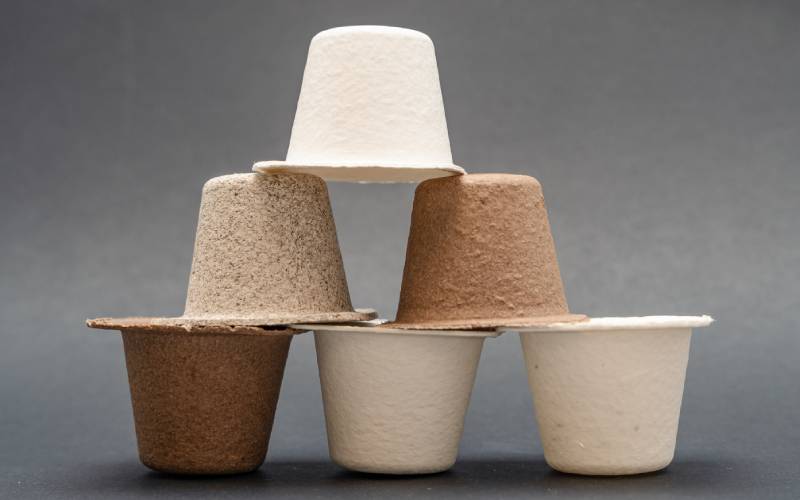
The first step was to turn paper pulp into a material dry enough to be injected while retaining its cohesion. By adding a very small quantity of a bio-based additive, Émilien Fréville developed a semi-solid pulp with innovative properties. The additive forms a thin lubricating layer around the fibres, allowing them to be injected without damage. It also stabilises the mixture by preventing the water and cellulose from separating.
This original process produces a genuine form of “cellulose modelling clay” that can be injected into moulds at room temperature to create complex shapes, such as caps, measuring spoons and bottle collars. These objects are currently made from plastic, but the new technology means they could be recycled through conventional paper recycling streams.

Taking the research a step further, Fréville also investigated the barrier properties of microfibrillated cellulose (MFC), which can protect packaging from grease, oils and gases such as oxygen. By combining fibre injection moulding with the injection coating of MFC, he developed a solution featuring two complementary innovations, now protected by two patents.
These promising results have led to the creation of a start-up project, Injectose, which is currently receiving support through the FitInnovE University Innovation Cluster (PUI) and a French Tech Lab grant. The project is now at the maturation stage, with a creation in June 2027. Its aim is to supply injectable cellulose-based materials that manufacturers can use in their existing presses with only minor adaptations. This represents a tangible route towards industrial technology transfer, illustrating both the innovative potential of bio-based materials and the commitment of Grenoble’s laboratories to a more circular economy.
* CNRS / UGA / Grenoble INP - UGA / Agefpi