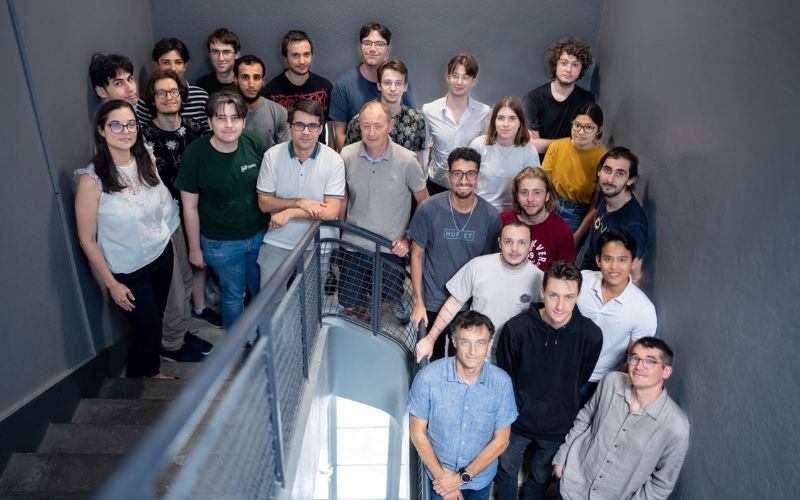
Created on 1 August 2025, the MADMAX team is the result of a partnership between Inria, CNRS, Université Grenoble Alpes and Grenoble INP – UGA within the TIMA laboratory*. It operates in a highly specialised field in France, with only a handful of teams working on the architecture and microarchitecture of general-purpose processors. Led by Frédéric Pétrot, a professor and researcher at Grenoble INP – UGA, MADMAX aims to develop innovative approaches to improving the performance and energy efficiency of computing systems amid profound technological change.
At a time of heavy dependence on US and Asian suppliers of advanced integrated circuits, mastering computer architectures has become a matter of digital sovereignty. “Europe cannot afford to lose this expertise,” Frédéric Pétrot emphasises.
When Moore, Dennard and Amdahl reach their limits
The name MADMAX explicitly refers to three foundational laws of modern computing: Moore’s law, Dennard scaling and Amdahl’s law. For several decades, Moore’s law predicted the doubling of the number of transistors in microprocessors every other year, while Dennard scaling ensured that power density remained constant as components became smaller. Amdahl’s law, meanwhile, states that any speedup achieved through parallel computing is inevitably limited by the sequential portion of a workload.
Today, all three are reaching their physical and conceptual limits. Transistors have become so small that current leakage invalidates Dennard scaling, while the irreducible proportion of sequential operations continues to constrain overall performance despite the widespread adoption of multiprocessor architectures. Against this backdrop, “we are entering a golden age for computer architecture,” in the words of Turing Award winners John Hennessy and David Patterson, quoted by Frédéric Pétrot.
Innovating inside processors: microarchitecture as a driver
In response to this paradigm shift, MADMAX has chosen to innovate as close to the hardware as possible, at the microarchitecture level—in other words, within the processor itself. The aim is to improve sequential performance by reducing the overhead associated with decisions made while programs are running. To achieve this, modern processors rely on sophisticated anticipation and prediction mechanisms capable of “guessing” the future behaviour of programs and thereby reducing execution time.
This work is one of the team’s core scientific areas and places MADMAX among the few French groups specialising in this cutting-edge field at the interface between hardware and software.
Memory architectures, artificial intelligence and energy efficiency
Beyond microarchitecture, MADMAX’s research encompasses several complementary areas. The team is particularly interested in multiprocessor-system architecture and memory hierarchies—a crucial issue in machines whose processors operate at much higher frequencies than their memory. The precise management of intermediate levels of memory directly determines the performance and energy efficiency of modern systems.
Another major area concerns the design of accelerator architectures dedicated to artificial intelligence. Because AI computations consume extremely large amounts of energy, the researchers are exploring specialised hardware approaches that can reduce numerical precision or compress data to limit energy consumption without compromising overall performance.
Finally, the team is developing computer-aided design, simulation and verification methods and tools. These are essential for designing and validating increasingly complex architectures, particularly in multiprocessor environments.
A team with strong Grenoble INP – UGA roots and close industry ties
MADMAX brings together eight permanent scientists, most of whom are lecturers and researchers at Grenoble INP – UGA, from Grenoble INP – Ensimag, UGA, and Grenoble INP – Polytech, UGA. Including PhD students and postdoctoral researchers, the team comprises around twenty researchers, reflecting the institution’s commitment to research-based education.
With a long history of close industry ties, the team maintains numerous collaborations with major companies in the sector, including STMicroelectronics, Kalray and Eviden. It is also involved in major French and European projects focusing on artificial intelligence and embedded systems, as well as several industry-funded CIFRE PhDs, illustrating its position at the interface between academic research and industrial innovation.
*CNRS / UGA / Grenoble INP - UGA
Photo credit: © Inria / Photo B. Fourrier