
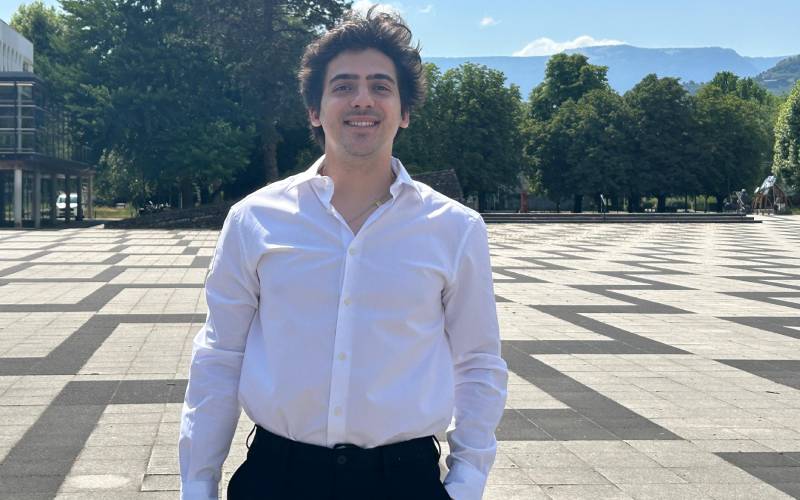
Lucas Varoto receives the 2025 UGA PhD Thesis Award for his research on Cu–Cr alloys

Lucas Varoto received a 2025 UGA Academic PhD Thesis Award for his research conducted at SIMaP* in collaboration with Schneider Electric. Combining innovative experimental and numerical approaches, he focused on optimizing the materials used in the electrical contacts of medium voltage vacuum circuit breakers.
In medium-voltage power grids, vacuum circuit breakers interrupt the current in the event of a fault without relying on SF₆, a gas with a very high global warming potential. “Vacuum has a particularly useful property: it is an excellent insulator. However, when the current is interrupted, an electric arc forms between the contacts, causing them to melt locally. The materials must therefore withstand extreme conditions,” explains Lucas Varoto.

To meet these requirements, the contacts are generally made from copper–chromium alloys. Their performance is closely linked to their microstructure, which remains poorly documented. Lucas Varoto started by comparing the microstructure and properties of alloys manufactured through different conventional processes. He used an advanced characterisation method combining X-ray tomography and machine learning, notably in collaboration with the ESRF. “We developed a comprehensive protocol to analyse these microstructures in three dimensions, something that had never previously been done for these alloys.” The analysis revealed the critical role played by Cu–Cr interfaces in electrical conduction and mechanical strength.

Additive manufacturing as a driver of innovation

During the second part of his PhD, Lucas Varoto turned to electron beam additive manufacturing, an approach that has received little attention to date for Cu–Cr alloys. “These alloys are immiscible in their liquid state, just like oil and water. However, by carefully controlling the rapid solidification inherent in additive manufacturing, we can influence the morphology of the different phases and improve the material’s properties.”
The results are promising: the new materials offer better mechanical, electrical and thermal performance than current industrial benchmarks. “This opens the way to higher-performance, more efficient contacts and to complex geometries tailored to each application,” he says.

Now a postdoctoral researcher at the Max Planck Institute in Germany, Lucas Varoto is broadening his expertise to include the design of sustainable alloys, taking into account the environmental issues associated with metal extraction and recycling. For him, the PhD Thesis Award represents significant recognition: “It acknowledges not only my scientific results, but also the rigour of my approach and the support provided by a highly stimulating research environment, both at SIMaP and Schneider Electric.”

*CNRS / UGA / Grenoble INP - UGA


Recueil d'articles