

Kraken: a new strategic supercomputer for research in Grenoble

With the new-generation CINAURA-Kraken supercomputer, Grenoble’s research community is gaining a new high-performance computing resource designed to address the rapid growth in scientific data and artificial intelligence applications.
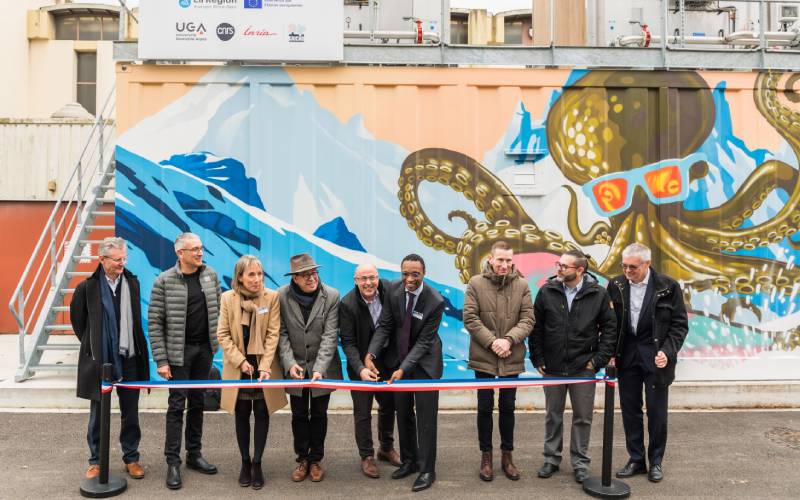
On Tuesday 27 January 2026, Grenoble’s scientific community gathered on the city’s scientific peninsula to inaugurate CINAURA-Kraken, a new supercomputer designed to sustainably strengthen local high-performance computing and data analysis capabilities. Installed at the Laboratory of Subatomic Physics and Cosmology (LPSC)*, this computing cluster marks a major milestone for the research ecosystem supported by Université Grenoble Alpes, Grenoble INP – UGA, CNRS and Inria.

A shared resource meeting growing scientific needs

Operated by GRICAD, the research support unit dedicated to computing and data infrastructure, the new platform addresses needs that have become essential across numerous scientific fields. Numerical simulation, modelling, large-scale data processing and artificial intelligence now play a central role in the production of knowledge, far beyond computer science alone. Kraken provides research teams with a resource capable of supporting these applications over the long term.

Delivering approximately eight petaflops of computing power—nearly one tenth of the capacity of a national high-performance computing centre—CINAURA-Kraken was designed to anticipate scientific needs over the next ten years. It complements and consolidates the existing range of shared resources, providing comprehensive support that encompasses computing, storage, data processing and the exploitation of research data. Open to Grenoble’s entire scientific community, it is designed for use by experienced researchers, PhD candidates and students working on data- and computing-intensive projects.

Beyond its performance, Kraken stands out for the key choices that guided its design. Housed in a modular container installed on existing infrastructure, it avoids the need to construct a new concrete building, thereby reducing its environmental footprint. The servers are cooled using a closed-loop water circulation system that comes into direct contact with the components. This optimises energy efficiency while keeping electricity consumption and the associated emissions under control.
 

Supporting digital sovereignty in public research

The supercomputer also forms part of a strong commitment to digital sovereignty. By hosting and operating computing resources locally, the partner institutions enable research teams to retain control over their data, methods and infrastructure at a time when these issues are becoming increasingly strategic. This autonomy is particularly important for sensitive projects, notably in healthcare, as the platform is intended to obtain certification for hosting health data.

With a total budget of €6.7 million, the CINAURA-Kraken project received substantial public funding through the 2021–2027 State–Region Planning Contract and the France 2030 investment plan. Funding was provided by the French government, the Auvergne-Rhône-Alpes Region, Grenoble Alpes Métropole and the European Union through the European Regional Development Fund (ERDF), illustrating the importance placed on digital research infrastructure at both regional and national levels.

* CNRS / UGA / Grenoble INP - UGA


Recueil d'articles