

Bridging Science Across Borders
Meet a Unite! Student at Grenoble's Summer School on Environmental Contaminants
Meet a Unite! Student at Grenoble's Summer School on Environmental Contaminants
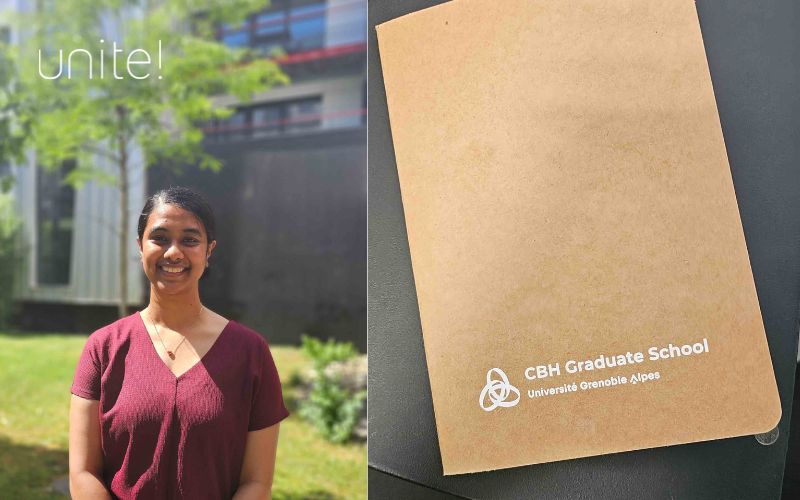
Serin Joby Parekkadan, a Master student from Technische Universität Darmstadt, travelled to Grenoble in late June to participate in "Shape the Future"—an intensive summer school on environmental contaminants organised by the CBH Graduate School, a programme at Université Grenoble Alpes (UGA).
Late June brought a unique gathering to Grenoble, France. For five days, students from across Europe converged on the Chemistry Biology Health (CBH) Graduate School to participate in "Shape the Future", an intensive summer school focused on one of the most pressing challenges of our time: environmental contaminants and their impact on human health.
Among the participants was Serin Joby Parekkadan, a Master student from Technische Universität Darmstadt. Like many students in the Unite! alliance, Serin had seized the opportunity to expand their horizons by joining peers from partner universities to tackle real-world scientific challenges in a collaborative, multidisciplinary setting.
We sat down with Serin to learn what drew them across borders and what stayed with them after an unforgettable week.
"My background is heavily rooted in synthetic and molecular biology, immunology and public health," Serin explained. "I wanted to travel to Grenoble to bridge the gap between environmental contaminants and their direct, tangible impacts on human health and disease progression."
This was precisely what the summer school offered: a chance to move beyond disciplinary silos. Over five days, participants engaged with leading scientific and industrial experts, explored the molecular mechanisms of contaminants, and worked in mixed teams to propose innovative research solutions for real-life contamination scenarios.
For Serin, one experience stood out. "The moments where we analysed the molecular mechanisms of contaminants. Seeing the direct pathway of how chemical pollutants trigger cellular dysfunction and pose severe threats to human health really reinforced why this intersection of science matters."
This sentiment, the power of connecting dots between disciplines, emerged again and again throughout our conversation.
When we asked what Serin learned from collaborating with students from different universities and scientific backgrounds, the answer was clear:
"It taught me that tackling public health crises requires a multidisciplinary approach. When you combine the perspectives of engineers, environmental scientists, and biomedical researchers, you can map out a problem from its ecological source all the way to its cellular impact on patients."
That integrated thinking is precisely what Unite! aims to foster, bringing together institutions, students, and researchers to solve complex challenges that no single discipline or university can address alone.
When we asked Serin to distil their experience into one sentence about what "shaping the future" means now, they said: "To me, shaping the future means utilising cutting-edge biomedical innovation to understand, prevent, and treat the complex human health challenges caused by our changing environment."
Amid the expert talks, laboratory visits, and project work, one thing caught Serin off-guard: "How quickly a group of strangers from completely different universities and scientific fields could click, align their goals, and become a tight-knit team in just a few days."
This rapid bonding, born from shared purpose and genuine intellectual exchange, is a hallmark of the best European educational experiences. It's also a reminder of what the Unite! alliance exists to create: spaces where students don't just learn alongside peers from partner universities, but genuinely collaborate, challenge each other, and grow together.
The CBH Graduate School's "Shape the Future" summer schools are intensive week-long programmes that bring together Master's and doctoral students to tackle real-world scientific and societal challenges. The 2026 edition on environmental contaminants welcomed students from UGA and from partner institutions as the Unite! alliance. The programme combined expert lectures, hands-on workshops, laboratory visits, and team projects, all conducted in English.
The summer school exemplifies how Unite! creates opportunities for meaningful mobility and collaboration.